
Impatience was a virtue at COP30!
Image Credit: UN Climate Change - Kiara Worth
Written by Areeba Hasan
Belém greeted COP30 with an atmosphere that was both humid and humming with expectation. Here, on the edge of the Amazon, the forest that has long been doing the heavy lifting to stabilize our climate, the weight of the moment was unmistakable.
Impatience Earth’s climate-philanthropy advisor, Raysa França, was among the thousands who arrived ready to listen, challenge, and contribute. She landed with a list of uncomfortable questions:
- Why does less than a penny of every climate pound reach the communities who sustain the Amazon?
- How are youth-led movements still expected to drive transformation while surviving on scraps?
- How can we build accountability so philanthropy steps up and funds the climate transition?
Across the week, from the Resilience Hub to an off-record conversation on racial justice, Raysa listened, spoke, interviewed, and added her voice to conversations spanning gender, climate justice, youth funding, climate finance, insurance, food systems, and Brazil’s philanthropic commitment for climate change.
Now, two and a half weeks later, as the noise of COP slowly fades, it feels like an important moment to gather what surfaced. What did we hear? What genuinely shifted? And how does large-scale climate ‘impatience’ show up when global attention turns towards it?
Here are some of the scenes, signals, and insights from the ground that stayed with us:
1. Care is the invisible pavilion
Before arriving, Raysa had heard a lot of commentary that Belém’s “infrastructure” would fail. But on the ground she experienced something different: strangers offered umbrellas during the rain to protect her equipment, WhatsApp pings of “você está bem?” (“are you okay?”) after a Blue-Zone fire, and locals giving directions and safety tips even when she hadn’t asked. The city’s welcome, its acolhimento, was the system that kept everyone upright despite some of the infrastructure’s challenges. There’s a lesson here for funders: the invisible systems and practices of community support count just as much as physical infrastructure
2. Groundwork is more relevant than ever
The final COP30 deal omitted the crucial wording on “phase-out of fossil fuels”, but the Just Transition Mechanism made it in. This is evidence of civil-society pressure – work that was funded and organised long before COP30 began. Policy outcomes mirror the groundwork movements are resourced to do. And as Farhana Yamin said in a recent EFN event on reflections from COP30: “It is challenging to expect ambitions that are not happening in domestic policy, highlighting the importance of local and national action.”
3. Gatherings are the glue that keep the system together
Jumping between the Blue Zone, the Global South House, House of the Insurance, House of Regenerative Agriculture and finance rooms, Raysa saw COP’s real value: people who normally work in different countries eating rice-and-beans at the same table, translating their slice of the climate action puzzle and realising “I’m not alone, my bit joins yours.” Trust was built simply because bodies were in the same place, but a lot of translation work between these worlds is still needed

4. Democracy is a venue-selection criterion
The halls felt energising because activists could march, sing and occupy the same city as the negotiators without reprisal – which is not always the case. This is proof that holding the meeting in a democracy (and funding the travel that gets people there) keeps the pressure alive inside the negotiating rooms. Yet,. even in a democratic country, Indigenous peoples reminded us of the lack of accessibility and inclusion in the process.
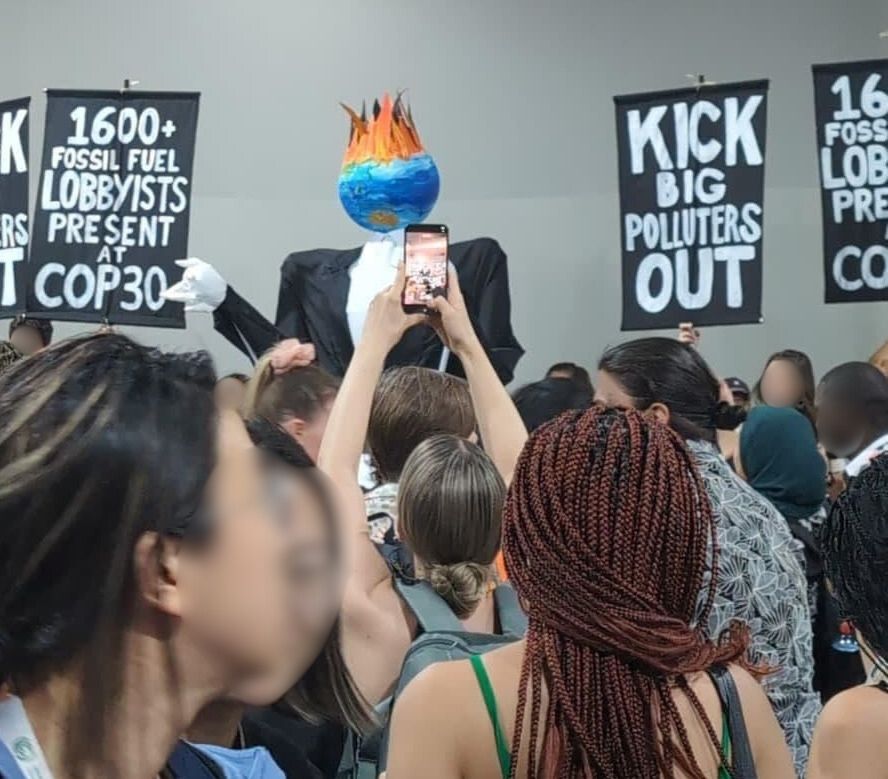
5. The protest that walked inside
On the 13th and 14th November the road to the Blue Zone was blocked by Indigenous leaders and protesters. After hours of stand-off, the COP30 president André Corrêa do Lago opened the gates and let the entire march inside. Raysa was in the queue when the barrier was lifted. An indigenous leader from the Tupinamba community told Reuters, “we can’t eat money.” IE’s takeaway for funders: the people who keep carbon in the ground rarely wear official badges; so fund the movements, not just the pavilions!
6. Youth grab the mic
At the Resilience Hub, Raysa joined Re-Earth, Youth4Nature and GAYO for the “Innovative Youth, Innovative Funders” panel. She argued that success should be measured by how much money young people move, not how much they receive. She made the case for youth-pooled funds, the role of intermediaries in channeling more resources to youth, and highlighted Roots & Routes Fund grantees as a recent example in action.
7. Philanthropy Day and the Brazilian Commitment on Climate Change
Under the historic house of Casa Balaio, philanthropy actors and organisations met for a conversation. Separately, Raysa spoke about the power of philanthropy and Impatience Earth’s work with the different national commitments for climate philanthropy at the GIFE panel celebrating the Brazilian Commitment on Climate Change. She highlighted the importance of community both for hosts and signatories, a cornerstone of our work at Impatience Earth. We heard about why signing the commitment is step zero; and step one is changing the mindset from “who we fund” to “how do we raise ambition for climate as a sector”
8. Global South House and accessibility!
Live sign-language interpretation, trilingual headsets, and a MC who described her own outfit for visually-impaired listeners before introducing panelists. No other side-event we entered built that much inclusion into it. Our learning: if we can bring inclusion into a pop-up pavilion, there’s no excuse for our application processes!
What are we taking away?
COP30 reminded us that impatience isn’t a flaw, it’s a catalyst. It’s the driving force behind the courageous interventions that shaped negotiations in Belém and beyond. As we look back on COP – the rainstorms, the protests, the side-rooms, and the conversations that continue long after the sessions end, one thing is clear: climate action moves fastest when communities, movements, and funders pull in the same direction.
At Impatience Earth, this is the work we show up for every day: helping funders understand where their resources matter most, and backing the people already repairing the systems we rely on. From regenerative agriculture to youth-led climate finance to indigenous movements and more, we support funders ready to step into this work with clarity and conviction.