
5 takeaways from the Funding, People and Place conference
Written by Alex Cameron-Smith and Sarah Farrell
- Labelling people as ‘hard to reach’ is outdated and holding back effective policy
- Flooding gets a lot of attention, but we also need to prepare ourselves for the invisible impacts of increasing heat
- Look back to look forward: the UK energy transition needs to be ‘just’ and build on our industrial heritage
- We’re in difficult waters, so let’s find (and fund) the navigators
- Philanthropy has always been important, but with dwindling public funding for community programmes it now has a critical role to play
In 1929 over four million people attended The North East Coast Exhibition world fair in Exhibition Park in Newcastle. It showcased cutting-edge technology and industrial innovation with products including the Hoover vacuum on display. Almost 100 years later, Impatience Earth was invited to a smaller gathering at the same Exhibition park, in the Palace of Arts’ building now known as Wylam Brewery.
Attendees were gathered for the first environmental conference hosted by the Community Foundation North East and the Environmental Funders Network. The conference showcased innovative examples of community programmes from across the North East, showing how the region is taking action to build place-based resilience in our era of increasing climate change.
At Impatience Earth, we have seen that a place-based focus is becoming increasingly important to our clients (philanthropic funders) and the organisations they fund, so Alex and Sarah were delighted to attend. We listened to some fantastic talks, including a keynote address from the indomitable campaigner and executive director of Uplift, Tessa Khan, who talked about the fair transition that needs to happen for workers in the energy sector and why it’s vital that lessons are learned from the pit closures in the 1980’s.
Here are our five main takeaways from the day:
1. Labelling people as ‘hard to reach’ is outdated and holding back effective policy
As Tony Gates, outgoing CEO of Northumberland National Park said in the opening session ‘impact takers are not policy makers’. Tony was referring to people who experience the immediate, often devastating, consequences of environmental and climate crises being largely left out of decision making processes. We know policies cannot work if they exclude people, yet this practice persists, often with whole demographics being labelled as “hard to reach”.
We need to change the way people are engaged and included – lack of participation does not mean people are not interested or they don’t care. The process for them to get involved is usually not accessible, clear, or relevant in the middle of the other urgent things they need to do.
We also can’t always depend on a few passionate community members to light the way – just as flying groups of birds on long distance migrations take turns to be at the front, people need rest and time to enjoy their lives too.
2. Flooding gets a lot of attention, but we also need to prepare ourselves for the invisible impacts of increasing heat
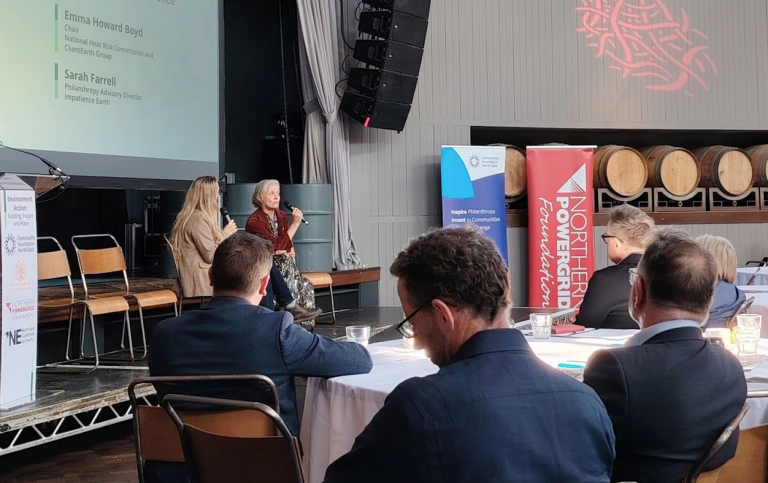
In the first ‘lakeside chat’ of the conference, Sarah asked climate resilience expert Emma Howard Boyd to share some of the lessons learned from her time leading the London Climate Resilience Review. The answer: “Borrow best practice where it already exists”. Emma talked about the balance we need to strike, between drawing on case studies and stories of success in different parts of the world whilst being careful to avoid a “copy and paste” approach, considering that most really good work is place-based and rightly prioritises the specific needs of the people that live there.
Emma also discussed the work she is involved with through Hera (formerly Climate Resilience for All), a women-led climate adaptation NGO that focuses on protecting women’s health, income and dignity as temperatures rise.
The conversation highlighted the specific gendered impacts of heat, such as menopausal women being at a higher risk of heat exhaustion and heatstroke, as well as the often invisible impacts on the UK economy through overheating workplaces and schools causing poor concentration, decision-making and lower productivity.
3. Look back to look forward: the UK energy transition needs to be ‘just’ and build on our industrial heritage
Adam Cooper, Director of Threads in the Ground, asked the room for a show of hands if they have relatives who worked in the mines. It was a reminder that coal was once the lifeblood of communities in the North East of England. While the closure of the last UK coal-powered plant was celebrated, we should take care to recognise the importance of this industrial heritage. Threads in the Ground is an organisation doing this locally; experimenting with new ideas and what they call “Carbon Heritage”. The organisation is taking inspiration from the Pitman’s Parliament, when representatives from each pit village used to gather to debate and influence policy, to create a new Durham Energy Council…
As we build our climate-resilient future that will be powered by renewables we can see that a huge transition is underway – but do we know for sure that it will be “just”? What will happen to the oil rig workers, the gas extractors, and their families and local communities around them as fossil fuel based power is phased out?
Tessa Khan, talked about the need to be both “fair and fast” – and that speed to convert our energy sources to renewables cannot compromise justice. People working in high carbon industries have skills and experience that should be valued in the new energy workforce. At the same time, communities where renewable infrastructure is being built should have a say in its development, and benefit themselves from new heat pumps and solar. Young people need to be encouraged into so-called ‘AI proof’ roles too – a new report from NPC provides some great guidance for employers to help widen access and build more inclusive pathways into the green workforce.
4. We’re in difficult waters, so let's find (and fund) the navigators
Speakers at the conference referred to the changing dynamics we’re witnessing in society. Brian Taylor from Reece Foundation asked: “Who are the navigators to take us through difficult waters?”
We know ourselves from conversations with friends and neighbours, as well as reports, that people are losing trust in authority. As a society we’re becoming more individualistic and increasingly seeking the company of ‘people who think like me’. A recent report by More in Common revealed that the word that comes to mind when asked about the UK was “shattered” – and we are all looking for someone to fix it. People are craving leadership in the face of all the escalating global challenges – and it’s time to look beyond traditional hierarchies to redefine what being a leader means.
Community leaders have the deepest understanding of local vulnerabilities, as well as the trust required to drive change forward. They are the small-scale actors that, stacked together, can form giant structures that demonstrate the impact of collective efforts. Those who can make climate information and engagement accessible, like artists and scientists, can ensure lived experience is built into research and design.
During the ‘pitch’ part of the conference, we heard examples of existing programmes and activities from across the North East that are engaging their communities through lived-experience of the issues they face. We particularly loved the brilliantly funny Huffty McHugh talking about the West End Women and Girls Centre, who are the first charity in the UK to long-lease a farm from the National Trust to become a safe space for women and girls to grow and harvest together with an emphasis on joy, fun and freedom.
We also heard from a group of young people who shared a film showcasing the environmental issues they felt most important for funders to address. It was a reminder that young people are often the best truth-tellers.
Above all, there is no single captain of the ship – we are all navigators, connected to and responsible for an ecosystem that is growing in many directions. Those with dominant system power and influence need to become more active in their advocacy for those with less, or step aside to let new thinkers and doers to lead.
5. Philanthropy has always been important, but with dwindling public funding for community programmes it now has a critical role to play
Philanthropic funding is uniquely powerful as both “patient capital” and that which can be given quickly to the people that really need it, including smaller, local groups that we heard make such a difference in the community. These groups are also exhausted by years of competing with each other for the same pots of public money, and/or losing out to bigger organisations with more capacity or those that already have an advantage from previous funding.
Putting money into social infrastructure at the local level will build trust by supporting networks, relationships and maintaining cherished spaces where people can gather. The secondary benefits are more connected people, less isolation, improved health and local pride, which are all more likely to enable climate action (although communities won’t call it that). This type of investment – with often non-traditional measures of impact – is not “risky” and should no longer be framed or dismissed as such.
We hope the message landed with the funders in the room: the leaders we need are already ‘doing the doing’ across our communities, but their efforts depend on flexible funding that enable them to focus on the work. Values-driven philanthropists can absorb risk and channel their funding into innovative approaches, filling widening gaps in the public sector and playing an important role in restoring a sense of hope.

Our thanks to Oscar Brennecke-Dunn, Ross Wilson, Emma Howard Boyd and everyone involved in this conference.